By Sleepy.txt
In the 2026 Chinese New Year, a sense of historical déjà vu is palpable.
Once again, tech giants are showering money during the Spring Festival, with the total amount exceeding 4.5 billion. This figure is more than double the combined subsidies of Didi and Kuaidi at the peak of the 2014 ride-hailing war, nine times the 500 million investment when WeChat Red Packets staged their "sneak attack on Pearl Harbor" in 2015, and even surpasses Baidu's peak spending of 1 billion during the 2019 Spring Festival Gala.
This time, all players are doing the same thing: enabling you to pay with just a spoken command.
This is highly unusual. Payment is something that has been solved quite well by QR codes. Take out your phone, unlock it, open the app, aim, scan, ding. To pay even faster, you can swipe a card or use NFC tap-to-pay. Why are AI companies insisting on using a more complex technology to replace an action that is already simple enough?
What exactly are they fighting for?
To answer this question, we must start with an unexpected event that occurred in the winter of 2025.
The Strangled Doubao Phone
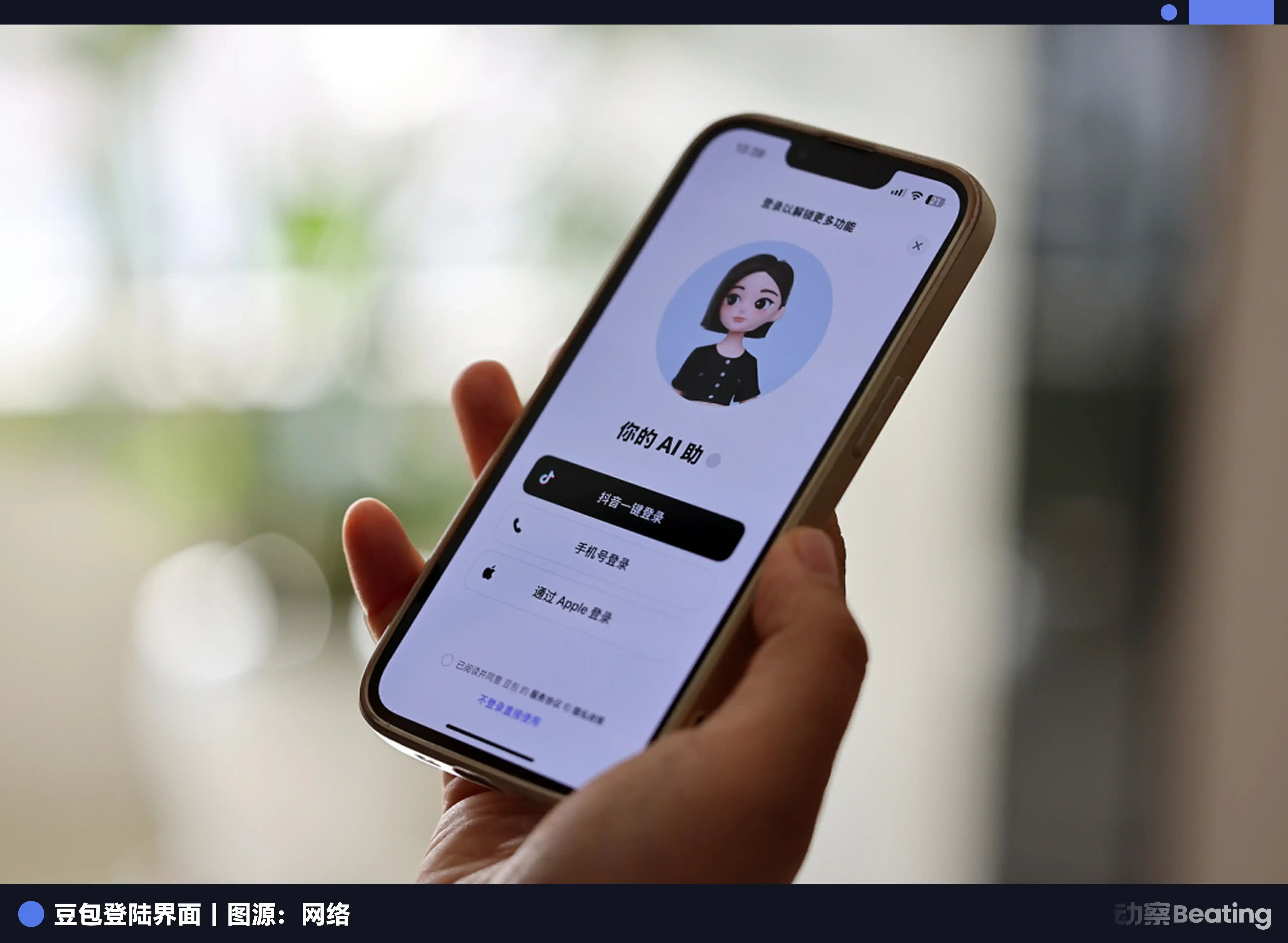
On December 1, 2025, the Doubao Phone was launched. A joint venture between ByteDance and ZTE, it was ambitiously designed to be a super AI butler.
In its vision, users would no longer need to open any apps; they would simply speak to the phone, and the AI would operate everything on their behalf—ordering food, hailing rides, transferring money, booking flights. It aimed to become that central nervous system unifying all services.
However, a storm soon erupted.
Shortly after launch, numerous users reported that when trying to log into WeChat using the Doubao Phone, they encountered pop-up windows blocking the login, with some accounts even being temporarily banned.
Subsequently, Alibaba's suite of applications began a collective "refusal of service." Taobao, Xianyu, and Damai all closed their doors to the Doubao Phone.
The conflict spread to the financial sector. Apps from several banks, such as China Construction Bank and Agricultural Bank of China, would pop up security warnings and force quit when they detected the Doubao Phone's AI assistant running.
Within a few days, an AI phone that had been highly anticipated was ostracized by the entire internet.
What did the Doubao Phone do wrong? It merely wanted to make things more convenient for users. Why did it face such severe封锁 (blocking)?
Because it challenged an ironclad rule of the past decade: traffic must form a closed loop within my ecosystem.
From the launch of WeChat Pay in 2013 to 2023, the Chinese internet experienced the golden decade of the super-app era. During these ten years, WeChat, Alipay, Taobao, Meituan, and others, through a series of brutal land-grab campaigns, built seemingly impregnable digital empires.
They are plazas of life, but also prisons of information. You can enjoy all the conveniences within the castle, but try to move something from one castle to another? Sorry, not allowed.
To this day, Taobao product links cannot be opened directly in WeChat, and Douyin videos cannot be easily shared to Moments—these are the most直观的 (intuitive) manifestations of these digital walls.
In stark contrast to the Doubao Phone's fate, Alibaba's Qwen was able to calmly complete 120 million orders over the 6 days of the Spring Festival because it inherently operates within a vast, closed ecosystem.
Qwen's Privilege and Alibaba's Internal Revolution
During the Spring Festival, every order you placed through Qwen was handled by Alibaba's own forces in the background: food delivery called upon Ele.me or Taobao Quick Purchase, payments went through Alipay, hotel bookings connected to Fliggy, ride-hailing linked to Amap.
Every step flowed smoothly within Alibaba's massive commercial system, forming a perfect closed loop.
Using AI as the needle, Alibaba strung together all the business lines it has accumulated over the past two decades—e-commerce, payments, logistics, local services, maps, entertainment, etc.—like pearls on a string, transforming them into a unified, seamless super Agent. Users no longer need to jump between Taobao, Fliggy, and Amap; they only need to converse with this single entry point, Qwen.
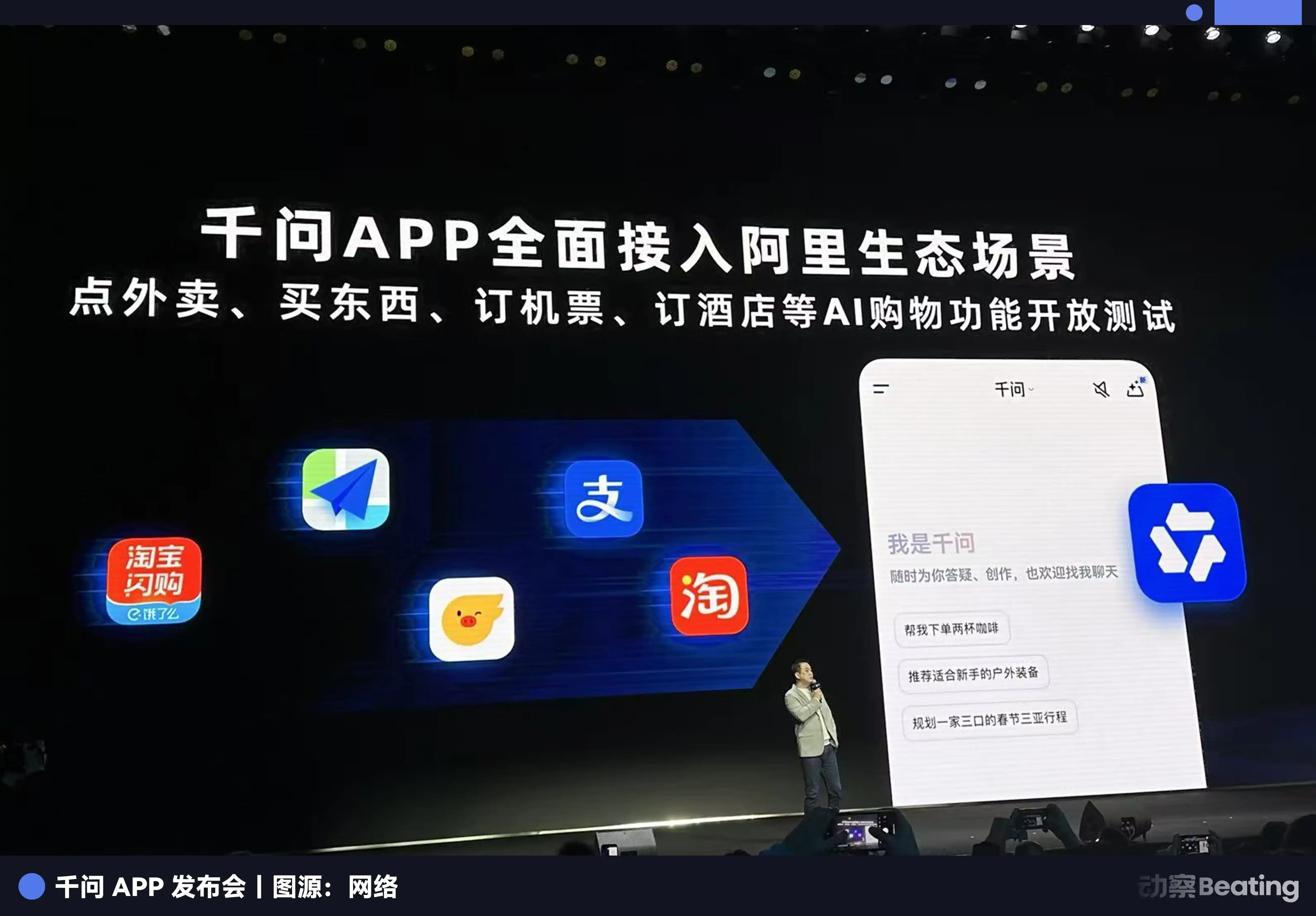
Wu Jia, President of Qwen's C-end Business Group, admitted in an interview that Qwen's unique advantage lies in the combination of the "strongest Qwen model" and "Alibaba's richest ecosystem."
He also revealed that Qwen plans to integrate the entire Alibaba ecosystem within six months and will continuously plan to introduce third-party partners in the future.
Please note the wording: "continuously plan."
This implies that, for the foreseeable future, Qwen will still prioritize cultivating its own plot of land. The so-called openness seems more like a polite phrase for a distant future.
Comparing Doubao and Qwen: Doubao aimed for horizontal integration, allowing one AI to call upon services from all giants. Qwen is focused on vertical integration, allowing one AI to call upon all services within its own ecosystem.
The former is a challenger, attempting to establish a new order; the latter is an incumbent, optimizing efficiency within the old order.
This brings to mind the PC internet era of the 1990s. When Netscape Navigator tried to challenge Microsoft Windows' operating system hegemony, Microsoft ultimately strangled the former king by bundling Internet Explorer with Windows.
In the face of absolute ecosystem advantage, any effort to unify the realm may be seen as an ambition that must be nipped in the bud.
So the question arises: If every giant is building its own AI Agent within its walls, what is the difference between the super-app era of ten years ago and now? Is it merely replacing a bunch of apps with one AI entry point?
From Land Grabs to Fish Farming
The difference lies in the granularity of competition.
In the super-app era, from 2013 to 2023, the core of the competition was land grabs—seizing the home screens of users' phones, making users live within my app.
WeChat dominated social, Taobao dominated e-commerce, Meituan dominated food delivery. Each app was a digital territory, and users migrated between different territories. The giants fought for your time, aiming to keep you within their territory for as long as possible.
In the AI era, the core of the competition is fish farming—taking over the user's "intent," making the user think within my AI.
Users no longer need to open apps; they only need to express intent, and the AI executes on their behalf. The competition has escalated from vying for usage time to the more brutal争夺 (contest) for decision-making power.
Let's return to that most common scenario: ordering a cup of coffee.
In the past, if you wanted a cup of coffee, you went through a familiar yet cumbersome process: unlock phone, find the delivery app, open it, type "coffee" into the search bar, browse a dazzling list of shops, enter one, select flavor, size, add to cart, jump to the cart page, confirm items, fill in address, choose payment method, finally click confirm order. The whole process required over a dozen clicks.
Now, you just need to say to Qwen: "Help me order my usual Americano."
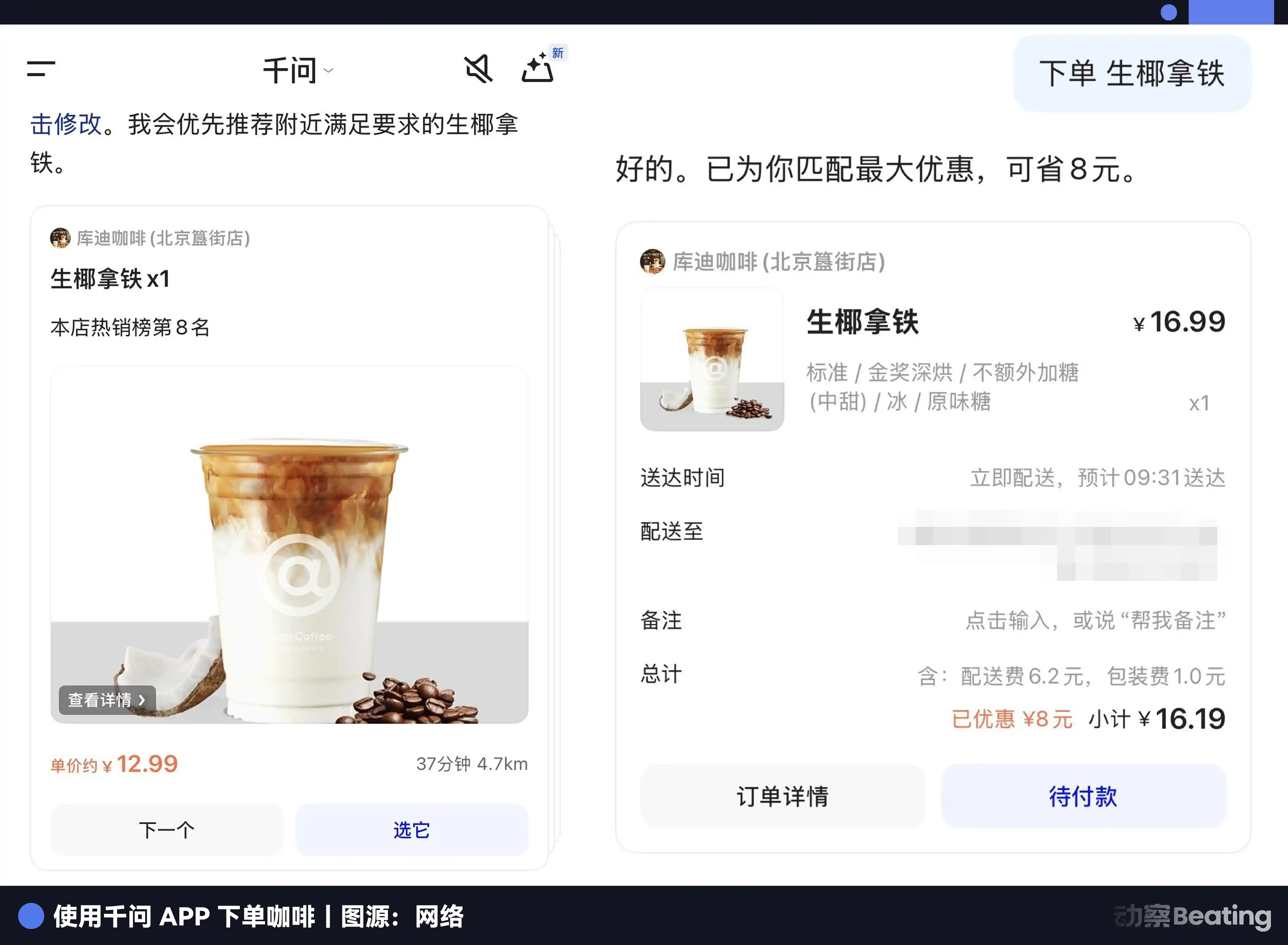
In the next few dozen seconds, the AI will automatically locate your position, recommend the brand you usually drink based on your order history, match the most powerful coupon, generate the order, and complete the payment.
You don't need to do anything; just wait for the coffee to be delivered. The superficial difference is in steps and time, but the essence is the transfer of decision-making power.
Commercial giants have shifted from enticing you to make decisions to making decisions for you.
In 1937, Nobel laureate Ronald Coase, in his paper "The Nature of the Firm," posed a fundamental question: If the market is the most efficient, why do we need seemingly cumbersome organizations called "firms"?
His answer: Because market transactions have costs, including the cost of finding trading partners, the cost of negotiation and contracting, and the cost of execution and supervision.
The history of commerce is a history of constant struggle with transaction costs. From department stores to chain supermarkets, from e-commerce platforms to mobile payments, every great leap in business models occurred because it drastically reduced transaction costs in a particular环节 (link).
The emergence of AI Agents is the first time in history an attempt is being made to compress the transaction costs of all links to nearly zero, especially that most stubborn cost hidden in the brain—the "decision cost."
The Pricing of Intent
When decision-making power itself can be代理 (proxied) by AI, the endgame of commerce becomes pricing the user's "intent."
In the past, we paid for goods—a cup of coffee for 30 yuan.
Later, we paid for services—a delivery fee of 5 yuan.
In the future, we will pay for "a perfectly fulfilled intent"—at 3 PM, when I'm feeling drowsy, drinking a cup of coffee in my favorite flavor, with the best cost-performance ratio.
The AI is no longer selling you a cup of coffee; it's selling you a perfectly satisfied afternoon.
This seemingly distant future revealed its clear轮廓 (contours) during the 2026 Spring Festival. In just 6 days, users said "Qwen, help me" 4.1 billion times, ultimately completing 120 million orders.
On average, one transaction was generated for every 34 expressions of intent. Where did the remaining 33 failed dialogues go? They didn't disappear; they were absorbed by the AI as nourishment.
The AI is studying, understanding, and memorizing these unfulfilled intents, so that next time, it can capture your desires more accurately.
Even more noteworthy are the 1.56 million elderly people who experienced food delivery service for the first time through Qwen. Behind this number lies a vast group forgotten by the mobile internet era. They couldn't use complex apps, couldn't figure out繁琐的 (cumbersome) coupons, but in the face of "conversation"—humanity's oldest form of interaction—the technical barrier was instantly leveled.
For the first time, technology proactively bent down to retrieve those forgotten by the times.
Looking back at the history of commercial development, we can see it is itself a history of "intent capture." From search engines (Google) in the 1990s, to e-commerce platforms (Taobao) in the 2000s, to super apps (WeChat) in the 2010s, and to today's AI Agents, every revolution represents a further deepening of the understanding of human intent.
So, in this battle for intent注定将 (destined to) reshape the future commercial landscape, where are the global players headed?
The Strategic Divide of Two Paths
The development of global AI Agents is evolving along two distinctly different paths. This isn't a matter of superiority or inferiority, but rather strategic choices determined by respective market structures and historical paths.
The first path is the vertically integrated ecosystem fortress.
Represented by giants like Alibaba and Tencent, which possess a complete "model + scenario + transaction" closed loop, the core logic is to use AI to deeply integrate their vast commercial ecosystems (e-commerce, payments, social, travel, entertainment), creating a super Agent with a seamless experience and closed data loop.
Users, through a single AI entry point, can mobilize the strength of the entire army group. The strategic advantage of this model lies in its极致流畅的 (extremely smooth) user experience, strongest data flywheel effect, and complete commercial闭环 (closed loop). In mature, fiercely competitive存量市场 (stock markets), this is the inevitable choice to reinforce the moat using one's own advantages.
The second path is the horizontally standardized open federation.
Represented by giants like OpenAI and Google, which possess powerful model capabilities but lack a complete commercial closed loop, the core logic is to attempt to establish a set of universal technical standards or protocols (like the Agent Payments Protocol), allowing AI to call third-party services across platforms and ecosystems, forming a loose federation.
The strategic advantage of this model is that it can theoretically break down ecosystem barriers, providing users with broader choices—its potential is huge. However, it faces strong practical resistance. Ecosystem giants, out of the need to protect their own commercial interests and data security, naturally resist this kind of calling, as the Doubao Phone's experience directly proves.
Vertical integration pursues极致 (ultimate) efficiency and control, like Apple's iOS ecosystem—smooth experience but closed system. Horizontal standardization pursues broad compatibility and choice, like the early Android ecosystem—uneven experience but full of possibilities.
From the browser wars of the 1990s, to the instant messaging wars of the 2000s, to the mobile payment wars of the 2010s, each time, the side with a more complete commercial closed loop and stronger control often gained the upper hand in competition.
The internet is not becoming more open; it is becoming more closed. It's just that the unit of closure has been upgraded from the APP to the AI.
Epilogue
Now, we can return to the question at the beginning: When the payment action itself becomes redundant, what exactly are the giants fighting for?
The answer is they are fighting for the priority processing right of intent.
The 4.5 billion in subsidies during the 2026 Spring Festival weren't buying "payment"; they were buying "intent." Every time you speak to the AI, every time you express a need, it's an exposure of intent. Whoever can capture more intent, whoever can fulfill these intents more efficiently, will occupy absolute initiative in the future commercial wars.
This is a war over the commercial entry point of the next decade.
Just like the 2014 Spring Festival red envelope war, where WeChat leveraged a mere 500 million in red envelopes to pry open the massive entry point of mobile payments; the 2026 Spring Festival AI war sees giants using 4.5 billion in subsidies to leverage that deeper, more fundamental entry point of intent.
The 2026 Spring Festival is just the beginning of this war. In the next five years, we will see more AI islands spring up, and more Doubao Phones徘徊 (lingering) outside the walls. The internet's walls will not collapse; they have been raised another ten meters.